

Making Meaningful Use of Routine Data from Regional Healthcare: DISTANCE:PRO Defines the Next Steps
Retreat in Freyburg at the Unstrut Lays Strategic Foundations for a Nationwide Digital Research Ecosystem
A large proportion of medical data is generated every day in the routine care provided by regional hospitals. Its potential for research is enormous, yet it remains largely untapped. How such data can in future be structured, used securely, and made available across sectors for scientific research was the focus of the DISTANCE:PRO project retreat held on 16 and 17 December 2025 in the picturesque town of Freyburg at the Unstrut.
Connecting Research and Regional Healthcare Based on DISTANCE
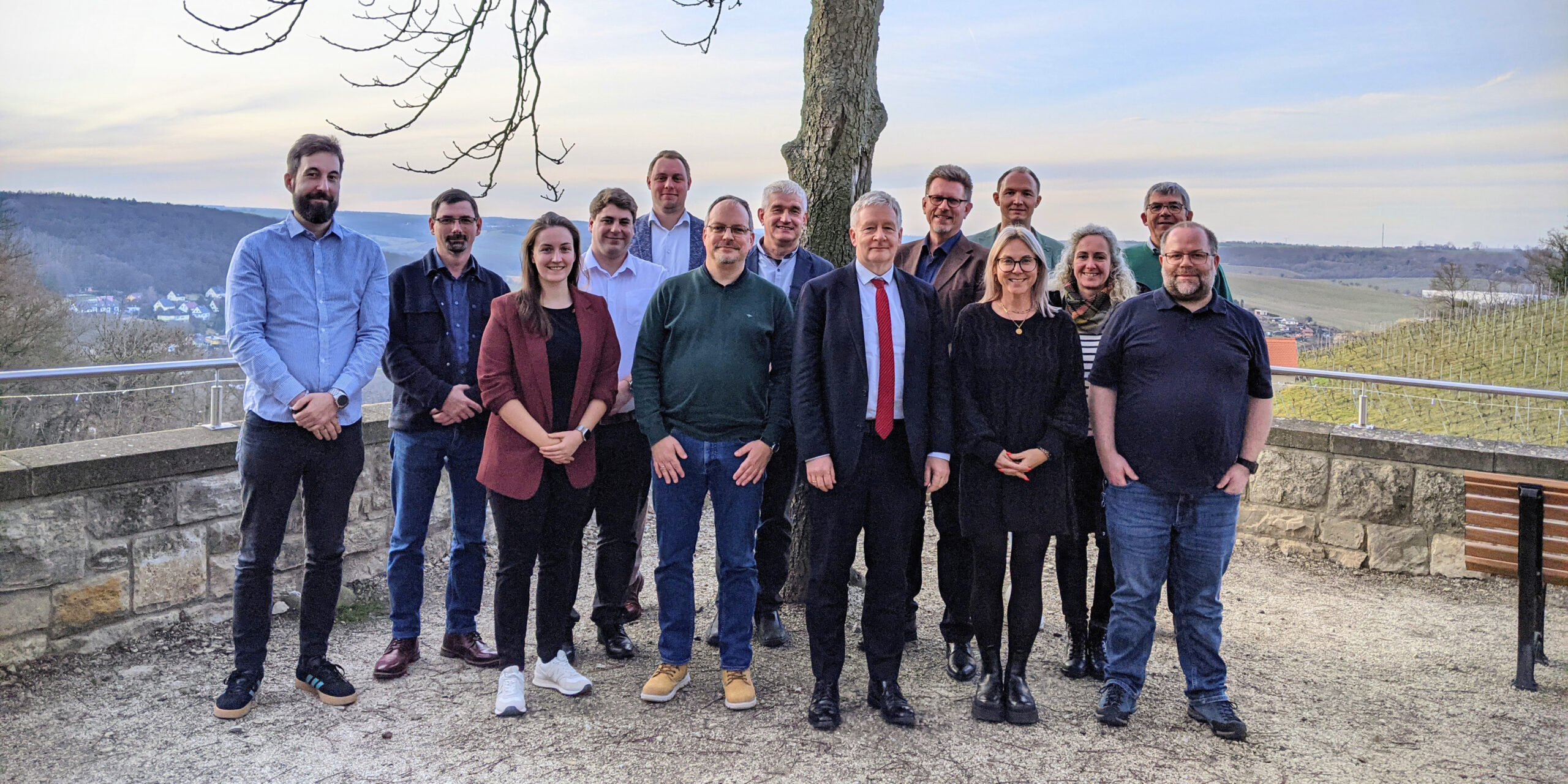
Fifteen project staff members came together to jointly specify the next steps for the DISTANCE:PRO project, which was launched in October 2025.
DISTANCE:PRO builds on the results of its predecessor project, DISTANCE. Within the Digital Hub DISTANCE, research data infrastructures of the Medical Informatics Initiative (MII) were, for the first time, extended to medical institutions providing regional routine care. The aim of DISTANCE:PRO is now to further develop these approaches and establish a nationwide, cross-sector digital ecosystem that sustainably links healthcare and research.
“We laid a very solid foundation for the digital networking of regional healthcare with DISTANCE. DISTANCE:PRO is where concrete implementation will take place, with a clear focus on tangible improvements for patients,” emphasized project lead Prof. Dr. Gernot Marx at the opening of the meeting.
External Data Integration Centers in Focus
Discussions on the first day of the retreat centered on the planned External Data Integration Centers (XTDIZ). In the future, these are intended to make routine data from regional healthcare institutions available for research, similar to the university-based Data Integration Centers established as part of the MII. The conceptual basis is the Digital Hub model developed in the DISTANCE project, in which data from routine care were centrally collected, anonymized, and made available for research purposes.
Antonia Schmidt, a research associate at the Fraunhofer Institute for Software and Systems Engineering ISST, presented key questions that must be considered when implementing the XTDIZ:
How should patients consent to the use of their data? Is project-specific consent sufficient, or should the broad consent model of the MII be used? And how can the XTDIZ be meaningfully integrated into existing structures of the Medical Informatics Initiative?
Participants also discussed the concrete process of data use—from submitting a data use request through to data access by researchers—as well as how the XTDIZ should be positioned in relation to larger initiatives such as the electronic patient record and the European Health Data Space.
Dr. Thomas Wendt, Head of the Leipzig Data Integration Center, added to the discussion with a presentation on the organizational requirements for external Data Integration Centers. A defining feature of the XTDIZ is that the data-providing institutions are organizationally separate from the XTDIZ itself. This gives rise to new questions, such as whether XTDIZ should be established as independent entities or integrated into existing Data Integration Centers.
Clinical Study as a Real-World Test of the Infrastructure
The second day focused on study planning. As in the DISTANCE project, DISTANCE:PRO will test data transfer via the XTDIZ using a concrete clinical use case.
While the predecessor project involved former intensive care patients documenting their health status using the PICOS App, the concept is now being expanded. In DISTANCE:PRO, the focus is on oncology patients prior to a surgical procedure. The aim is to capture and compare their health status over an extended period of time.
The app used in DISTANCE:PRO is intended to incorporate feedback from previous PICOS App users and provide patients with a clear overview of their entire health trajectory. At least 300 participants are planned: 200 participants will document their health status using an app and a wearable device, while a further 100 will serve as a comparison group.
Data collected will include physical activity, sleep, pain perception, and psychological stress. The study aims to make potential improvements in quality of life through the use of digital applications measurable, while simultaneously testing the performance of the new data infrastructure under real-world conditions.