

Medical data and biosamples from a single source: How the Data Integration Center and the Halle Biobank jointly connect healthcare and research
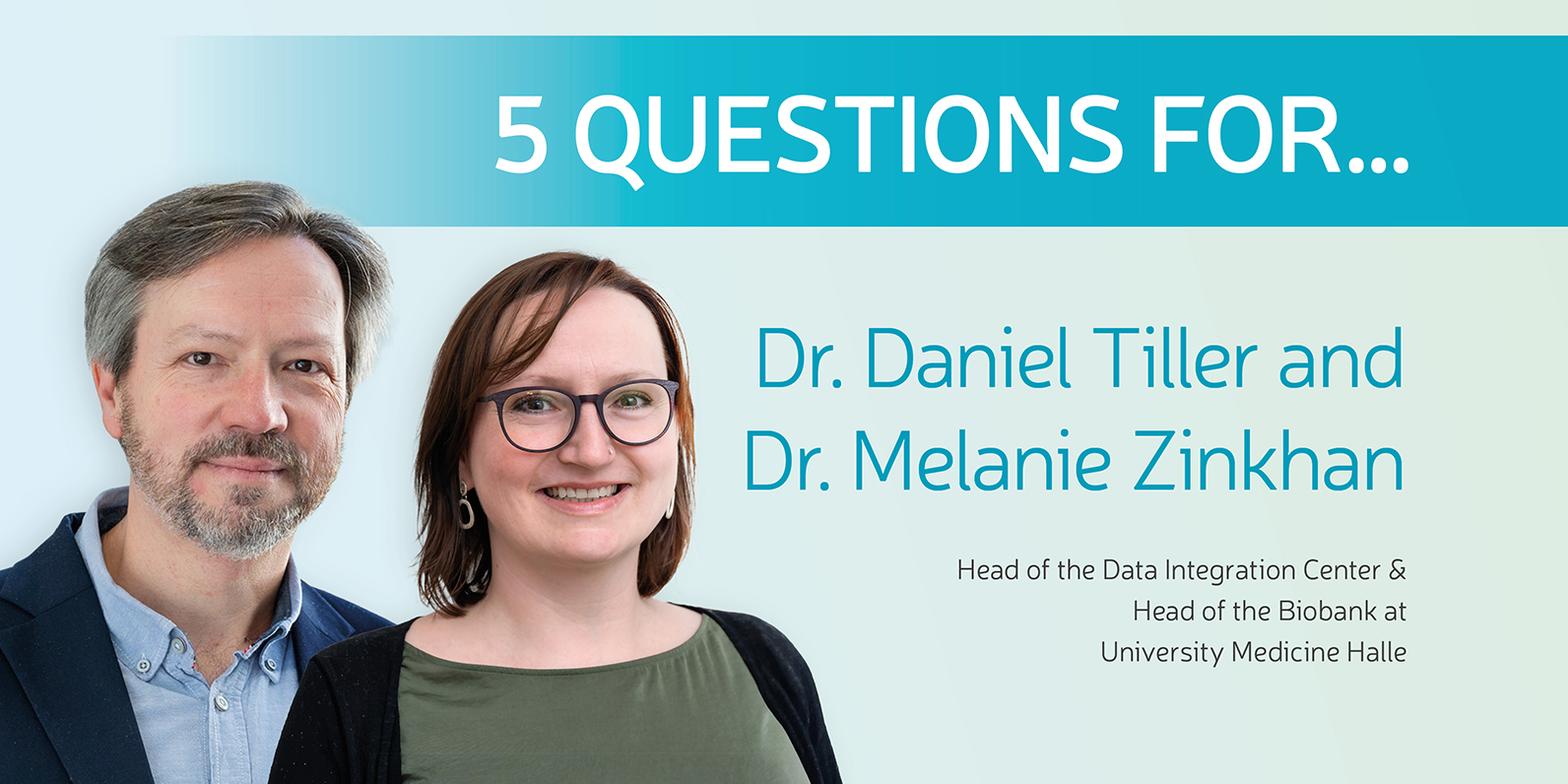
5 Questions for… Dr. Daniel Tiller and Dr. Melanie Zinkhan
Since 2022, the Data Integration Center and the Biobank at University Medicine Halle have been collaborating to support medical research at the site. Meanwhile, more than 10,000 patients in Halle have consented to the use of their medical data and biosamples from routine care. But how do these data and samples reach researchers? And how do the two institutions leverage their synergies? This, Dr. Melanie Zinkhan, Head of the Biobank, and Dr. Daniel Tiller, Head of the Data Integraion Center at University Medicine Halle, explain in this interview.
When you present your work, you usually appear together. What does your collaboration look like, and why is it worthwhile?
Dr. Melanie Zinkhan: The Data Integration Center and the Biobank were established at roughly the same time here at University Medicine Halle. From the very beginning, the aim was to leverage synergies. Both institutions support medical research: the Data Integration Center on the data side, the Biobank with biosamples. I think the greatest advantage for us is that we collect a joint patient consent for the use of medical treatment data and biosamples. Building on this, we have established harmonized processes for consent management and the collection of biosamples.
Let’s assume a researcher wants to request data and corresponding biosamples from the Data Integration Center Halle. What important steps do the data go through from the moment they are collected to their provision — from both the Data Integration Center and Biobank perspectives?
Dr. Daniel Tiller: The starting point for the data is always the patients’ consent (Broad Consent). Once it is available, data and biosamples can be collected on the wards and used for research projects. All data — including metadata on the biosamples — are stored at the Data Integration Center, while the samples themselves are stored in the Biobank. We also have a joint transfer office and a shared application form through which data and samples can be requested. There are two separate committees responsible for approving usage projects: at the Data Integration Center, this is the Data Use and Access Committee (UAC), and at the Biobank, the Biobank Allocation Committee. For joint applications, the Biobank management participates in the UAC to stay informed about relevant projects and to check sample availability. After the UAC of the Data Integration Center approves the data usage request, the Biobank Allocation Committee decides on the provision of the biosamples.
How do researchers apply for data and biosamples at the DIZ Halle?
Dr. Daniel Tiller: There are two routes: via the German Portal for Medical Research Data (FDPG), where cross-site feasibility queries and data usage applications can be submitted, or locally via our REDCap-based platform. For a local application, using biosamples is possible; for an application via the FDPG, this is not yet the case. This is because using biosamples always requires a local cooperation partner.
Dr. Melanie Zinkhan: When researchers need biosamples for their projects, we usually conduct a feasibility query in our biobank information system by checking which samples meet the desired criteria. If additional data from the Data Integration Center are required, the process continues in the previously mentioned REDCap form from the Data Integration Center. We then jointly handle the technical processing of the usage applications.
The Data Integration Center Halle is participating in the new Digital Hub (DigiHub) care:ecoHUB, which — unlike previous projects of the Medical Informatics Initiative (MII) — focuses on nursing care. What is this project about, and what role does the Data Integration Center play?
Dr. Daniel Tiller: Care:ecoHUB is officially the seventh DigiHub but was developed somewhat differently than the other six MII DigiHubs. It is a subproject of the Innovation Region for Digital Transformation in Nursing and Health (TPG). The goal is to pool and harmonize nursing data from various institutions for the first time. To achieve this, the Data Integration Center expands its role: it no longer integrates only data from the university hospital but also data from five nursing care institutions across five districts in southern Saxony-Anhalt. For this purpose, we are defining and implementing a nursing dataset — something that has not previously existed in this form. This dataset will initially represent the degree of care dependency based on the data collected in the nursing facilities.
Additionally, digital nursing innovations such as sensors or exoskeletons will be deployed and evaluated by the Data Integration Centers. The challenging aspect of the project is that it involves not just five different institutions, but also five different care settings: acute care, residential long-term care, outpatient care, home care, and a municipal health center.
What other plans and joint projects do you have for future collaboration?
Dr. Melanie Zinkhan: One of our largest current projects is establishing the Broad Consent for children and adolescents as well as an associated biosample collection.
Dr. Daniel Tiller: In Halle, additional modules of the MII Broad Consent (e.g., mental health), patient consents collected within the Model Project for Genome Sequencing, and further consent modules for local projects that collect biosamples based on the MII Broad Consent are currently being implemented. Furthermore, we are working on making additional datasets — especially in oncology — accessible for research.